
Choosing a brand or company name is one of the most consequential decisions an entrepreneur makes.
The name becomes the foundation of the brand, represents its values, and forms the basis on which trust is built over time. Yet the process of verifying whether a name is actually available is far more complex than most founders anticipate.
Data reveals the scale of the problem. Over half of founders (52%) experience name or domain issues within five years of launch, and 18% almost one in five change their name within that period.
In a study of 138 AI-generated brand names, 42% could not be registered as a .com at any price because someone already owned them. The average cost of a rebrand exceeds $200,000 and 21% of startups rebrand within their first year.
These numbers underscore a fundamental truth: checking name availability is not a single search but a multi-layered legal, digital, and strategic exercise that must be conducted across company registries, trademark databases, domain registrars, and social media platforms.
What Availability Actually Means
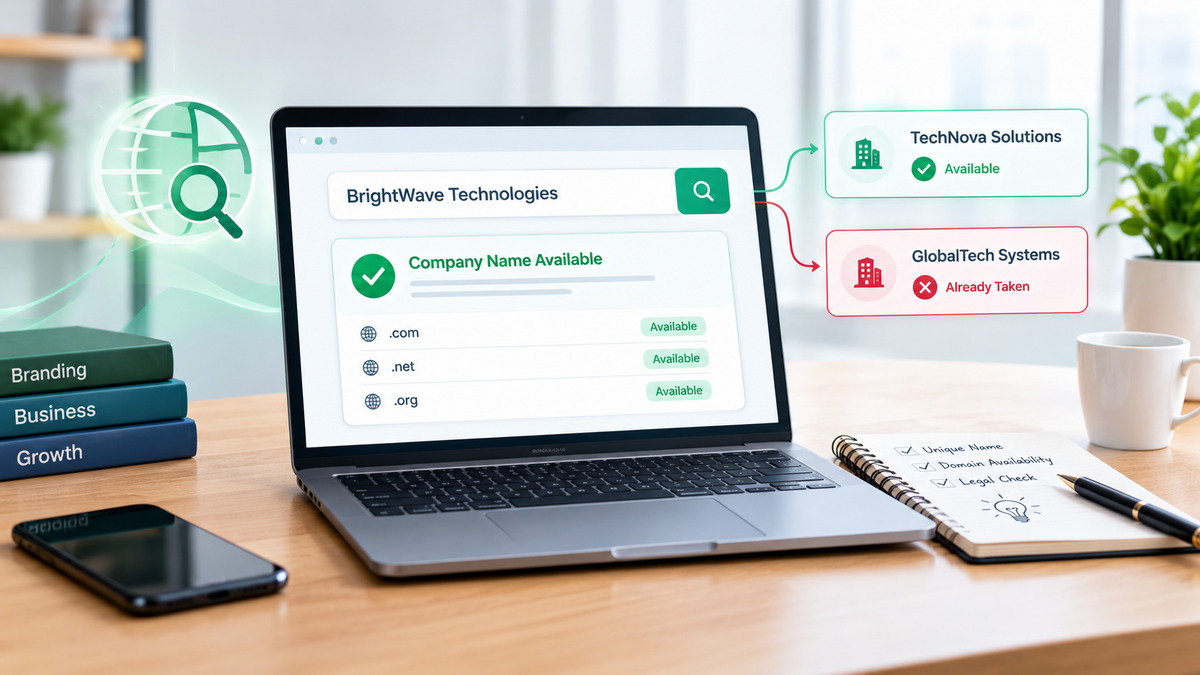
A name is only truly available when it clears four separate gates:
|
Gate |
What It Checks |
Consequence of Failure |
|
Company Registry |
Whether an identical or similar company/LLP name is already registered |
Rejection of incorporation application |
|
Trademark Database |
Whether the name infringes an existing registered or pending trademark |
Legal action, forced rebrand, damages |
|
Domain Availability |
Whether the matching domain (especially .com) can be registered |
Loss of digital identity, marketing friction |
|
Social Media Handles |
Whether consistent usernames are available across platforms |
Fragmented brand presence |
In Australia, for example, business name availability is explicitly described as "a three-layer check, not one search ASIC approval, trade mark clearance, and digital availability all need to align". The same principle applies globally.
Methodology for Checking Name Availability
Step 1: Conduct a Company Registry Search
Every country maintains a national register of company names. These searches are typically free and can be conducted online.
India MCA Portal: The Ministry of Corporate Affairs (MCA) provides a free "Check Company/LLP Name" search on the MCA21 Version 3 (V3) portal.
Entrepreneurs must verify name availability through the MCA and obtain approval via the RUN (Reserve Unique Name) service.
Critically, the MCA applies a phonetic similarity standard: names that merely sound like an existing entity are equally at risk.
Recent rejections include "Vira Lifesciences" (similar to "Veera Lifesciences"), "Meet Technologies" (similar to "Met Technologies"), and "Carezen Pharmaceuticals" (similar to "Zencare Pharmaceuticals").
A Non-Objection Certificate (NOC) will not be considered in cases involving identical or similar names such applications are liable to be rejected outright.
The MCA has also advised that names must not contain words creating an impression of association with the government or regulatory bodies, words like "Bank" require RBI approval, "Insurance" requires IRDAI approval, and "Chartered Accountants" requires NOC from ICAI.
United States: Company registration is handled at the state level. Each Secretary of State maintains a business entity search. Delaware, Wyoming, and Nevada are popular incorporation states, each with their own search portals.
Federal trademark searching is conducted through the USPTO's Trademark Electronic Search System (TESS) at tmsearch.uspto.gov.
United Kingdom: Companies House maintains the index of company names, storing details of over 4.5 million companies.A name can be rejected if it is the "same as" an existing one or "so similar that the two could be confused".
Companies House also restricts sensitive words such as "British," "Royal," "Government," "Banking," "Dental," and "Insurance".
Canada: The Nuans system is the Government of Canada's business name and trademark search tool. It uses a powerful algorithm to list all Canadian corporate names and trademarks that are similar or identical to the searched name.
A Nuans report is a five-page document showing corporate names (3 pages) and registered trademarks (2 pages) that resemble the proposed name phonetically or graphically.
Australia: Business names are registered nationally through the Australian Securities and Investments Commission (ASIC).
ASIC will refuse to register a name if it is identical or nearly identical to an existing registered business name or company name, or if it contains restricted or offensive words.
Singapore: The Accounting and Corporate Regulatory Authority (ACRA) provides a free entity search at acra.gov.sg or bizfile.gov.sg.
Straightforward names are typically approved within about three working days, though names requiring referral to authorities take longer.
Ireland: The Companies Registration Office (CRO) provides a free web search facility at cro.ie.
Importantly, the CRO does not check proposed business names against names on the registers of companies, business names, or trademarks, the responsibility is on the applicant to conduct comprehensive searches.
Step 2: Search Trademark Databases
Trademark searches are distinct from company registry searches and are equally critical. A name can be accepted by a company registry but still infringe someone's trademark.
WIPO Global Brand Database: This free online tool provides access to over 75.5 million records from 89 data sources, including the Madrid System for international trademarks, the Lisbon System for appellations of origin, and participating national and regional IP offices.
It includes 3.75 million records from the UK IPO, 3.48 million from France's INPI, and millions more from other jurisdictions.
United States (USPTO): The USPTO offers both basic and expert search modes. Basic mode allows drop-down searches by wordmark, goods and services, owner, serial number, and registration number.
Expert mode provides field tag searching, coordinated class filtering, and result tagging.
A critical limitation, USPTO search only uncovers federally registered trademarks, it will not find trademarks with state or common law rights that could impact your ability to use your trademark in a particular locality.
European Union (EUIPO): The EUIPO provides eSearch plus and TMview, both free online databases that allow users to check trademark availability across national, international, and EU levels.
India (IP India): The IP India Public Search is the official online trademark search system provided by the Government of India under the Controller General of Patents, Designs & Trade Marks (CGPDTM).
It allows users to check for registered and applied-for trademarks. The MCA advisory directs applicants to cross-check proposed names against the Trade Marks Registry, matching the NIC code to the relevant trademark class.
United Kingdom (UKIPO): The UK IPO maintains a searchable trademark database with over 3.75 million records dating back to 1876, accessible through the WIPO Global Brand Database.
Step 3: Check Domain Availability
The .com domain space is extraordinarily crowded. As of March 2026, the .com domain base totaled 163.6 million registrations, and the .net domain base totaled 12.4 million.
All possible 2-letter and 3-letter .com domains have been registered since the late 1990s. A study of Fortune 100 brand names found 100% registration in .com, 84% in .net, and 76% in .org.
Domain availability can be checked through ICANN-accredited registrars as well as bulk WHOIS lookup tools. The Domain Name Industry Brief (DNIB) reports that many short, memorable .com domains are already registered, held defensively, or owned by investors.
Step 4: Check Social Media Handles
Brand consistency across social platforms is essential for digital marketing.
Tools like NameSniper, brandcheck, and the Brand & Username Availability Checker API allow users to check a brand name or handle across 9 social platforms and any domain extension in a single run
Platforms to check include Instagram, TikTok, X (Twitter), YouTube, LinkedIn, Facebook, Threads, Pinterest, Reddit, Snapchat, Bluesky, GitHub, and npm.
Country-Specific Guides
India: A High-Complexity Jurisdiction
India presents unique challenges due to its dual-layer system of company name registration (MCA) and trademark protection (IP India), combined with strict phonetic similarity standards.
Key steps:
-
Search the MCA V3 portal for existing company and LLP names.
-
Run the same names through the IP India trademark database.
-
Check for regulated words requiring NOC from bodies like RBI, IRDAI, ICAI, or ICSI.
-
Verify the NIC code matches the trademark class of any existing marks.
The MCA has published a detailed advisory with real examples of rejected applications, demonstrating that even minor phonetic variations (e.g., "Vira" vs. "Veera," "Meet" vs. "Met," "DenHilz" vs. "Den Hills") result in rejection.
United States: State-Level Registration and Federal Trademarks
The US system requires checking both state-level business registries and the federal USPTO trademark database.
A crucial limitation, the USPTO search only covers federal trademarks, not state or common law rights.
The USPTO recommends a seven-step federal trademark search strategy, including searching TESS at a Patent and Trademark Resource Center or at home with internet access.
United Kingdom: Companies House and Sensitive Words
The UK system is relatively centralized through Companies House, which maintains a searchable index of over 4.5 million companies.
However, Companies House approval does not guarantee trademark clearance, a name can be accepted by Companies House but still infringe someone's trademark.
Companies House does not offer name reservations, a name is only protected once the company is officially registered.
Canada: The Nuans Advantage
Canada's Nuans system is unique in that it searches both corporate names and trademarks simultaneously, providing a more comprehensive preliminary search than many other jurisdictions.
Australia: Three-Layer Verification
Australia's ASIC registration is national, but the government explicitly advises that ASIC approval, trade mark clearance, and digital availability all need to align. ASIC can reject names that are too similar in sound, structure, or meaning, even if not identical.
Singapore: Fast-Track Approval
Singapore's ACRA provides a relatively efficient process, with straightforward names typically approved within three working days. The recommended sequence is: search the name, search the trade marks register, clear both, then commit to branding.
Ireland: Applicant Responsibility
Ireland's CRO does not check proposed names against trademark registers, the entrepreneur bears full responsibility for ensuring the name does not infringe existing rights.
Common Difficulties and Pitfalls
Phonetic Similarity Traps
The most underestimated risk is phonetic similarity. The MCA's recent advisory provides compelling evidence: "Vira Lifesciences" was rejected for resembling "Veera Lifesciences", "Meet Technologies" was rejected for resembling "Met Technologies", "Carezen Pharmaceuticals" was rejected for resembling "Zencare Pharmaceuticals". These are not identical names, they merely sound similar.
The NOC Myth
Many entrepreneurs believe that obtaining a Non-Objection Certificate from an existing company with a similar name will resolve the issue. This is false.
The MCA has explicitly stated that NOCs will not be considered in cases involving identical or similar names, and applications will be rejected regardless.
Domain Scarcity
The .com domain space is effectively saturated for short, common words. All 3-letter .com domains have been registered since the late 1990s, and >99.9% of 2-letter .com alpha names are taken.
Founders must often compromise on domain names or pay premium prices on aftermarket platforms.
Jurisdictional Fragmentation
A name available in one country may be taken in another. International expansion requires checking each target market's company registry and trademark database separately.
The WIPO Global Brand Database covers 89 data sources, making it the most efficient starting point for multi-jurisdictional searches.
Social Handle Inconsistency
Even if a name is available as a company name and domain, social media handles may be taken on one or more platforms. This fragments brand identity and complicates marketing efforts.
The Cost of Getting It Wrong
The financial consequences are severe. The average rebrand costs over $200,000, and 21% of startups rebrand within their first year.
Additionally, 18% of founders found that customers struggled to spell or pronounce their name, and 12% had difficulty acquiring their exact-match domain.
Recommended Workflow
For entrepreneurs operating in English-speaking markets including India, the following workflow maximizes the chances of securing a viable name:
-
Generate a shortlist of 5 - 10 candidate names using AI name generators or brainstorming.
-
Conduct a preliminary knockout search on the WIPO Global Brand Database to eliminate names with obvious conflicts.
-
Search the national company registry for each target country (MCA in India, Companies House in the UK, USPTO/state registries in the US, Nuans in Canada, ASIC in Australia, ACRA in Singapore, CRO in Ireland).
-
Search the trademark database for each target jurisdiction (IP India, USPTO, UKIPO, EUIPO, WIPO).
-
Check domain availability for .com and relevant country-code TLDs.
-
Check social media handles across all major platforms.
-
Consult a local IP attorney before filing, especially in India where phonetic similarity standards are particularly strict.
-
File for trademark protection as soon as the name is finalized to secure priority rights.
Conclusion
Checking brand or company name availability online is a multi-layered exercise that requires diligence across company registries, trademark databases, domain registrars, and social platforms.
The data is unambiguous: 52% of founders encounter name or domain problems within five years, and 18% end up changing their name entirely.
In jurisdictions like India, where phonetic similarity standards are applied rigorously, the risk of rejection is particularly high.
The most reliable approach is systematic: search every relevant database, document your findings, and consult legal professionals before committing to a name.
The cost of a thorough availability check typically a few hours and minimal expense is negligible compared to the $200,000+ average cost of a forced rebrand.
In the digital economy, a brand name is not just a label, it is a legal asset, a domain, and a social identity that must be secured across every dimension of the market.